

Modiano's Paris
A city, a Nobel laureate, and writing so good it hurts.

Some things, you keep coming back to.
Whether books, or travel to the same places over and over, I have a small number of fixed points in my reading and road life that I can’t shake—and I hope I never will.
Patrick Modiano, and the Paris of his writing since the late 1960s, is high on this list. He won the Nobel Peace Prize in Literature in 2014. The Nobel Committee praised him in fawning terms even for them, calling Modiano an interpreter of “ungraspable human destinies” and “a [Marcel] Proust of our time.” Proust, another French novelist, and the author of In Search of Lost Time (1927), has been called the greatest novelist of the 20th century. (Not everyone agrees.)
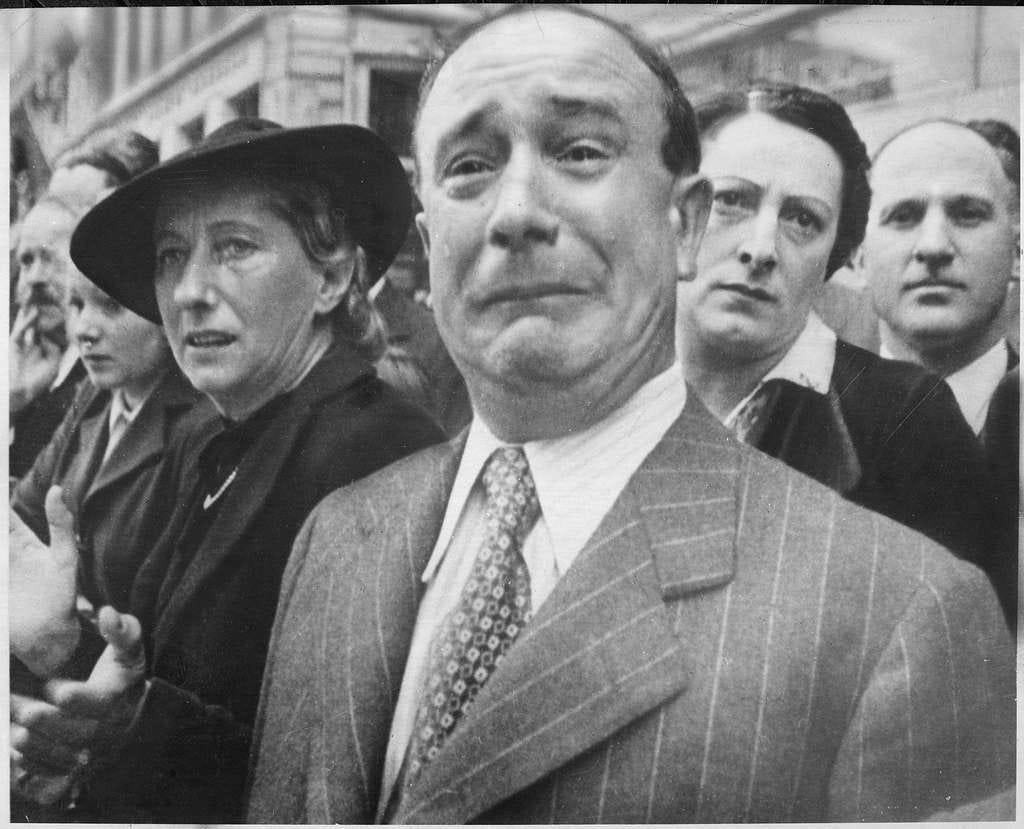
Photo: A man weeps as German soldiers march on Paris, June 14, 1940. Public domain
For Modiano, born outside Paris in 1945, the unusual nature of his parents’ livelihoods—his Belgian mother, an actress; his father, with Greek-Jewish roots, a black marketeer—have long served as foundational literary material for the son Modiano. The young man, who his parents often neglected, recounts early years broke and bumming around the city. He never went to college, yet managed to smash into the heights of the Parisian literati, besting even them. His Nobel seems proof of that.
The writer’s work is often summarized in the term autofiction, or fiction based heavily (or almost entirely) on his own, real life. Declared fiction, the work looks like a telling of true stories, papered over as imaginary. Modiano helped pioneer the genre. Other periods might call a writer’s harvesting of one’s own life for fiction either poor taste, lazy, or both.
Whatever the merits or demerits of Modiano’s genre, his Paris is often the true protagonist of his stories. The city is stage for the historical questions with which Modiano, like much of France, grappled after World War II—the conflict that ended as the writer’s life began. As a country under Nazi occupation for more than four years, postwar France has long struggled with, or preferred to ignore, its painful wartime past and the French-German collaborations of its leaders and people.
What remained in postwar France, emerging as it did from the horrors of conflict, produced public, personal, and moral ambiguities for an entire country.
Thus Modiano provoked a response on long-festering issues of memory. His books posed questions that demanded answers from those French then in power. The truth, as he wrote it, could hurt. It made great reading for the rest of us.
The Nobel Committee, in its adjudication, worked Modiano’s prize-worthiness down to this:
“…For the art of memory with which he has evoked the most ungraspable human destinies and uncovered the life-world of the occupation.”
Returning to the topic of Paris itself, I reckon Modiano’s constant references to the French capital manage two narrative functions, depending on who’s reading.
For the French person—one in any way familiar with the streets of Paris—Modiano’s literary geography anchors his stories in verisimilitude. It happened here, in the streets we know.
For the foreigner like me, it reminds one that the Paris of shady characters, hard luck, and its dream-like boulevards and avenues really do exist. This is true for the repeat visitor and the maybe-one-day aspirant. Whether the stories are strictly true, they remain plausible. Imagine this happening, in the streets we’ve visited, or want to. Don’t we want to?
Consider the following excerpt, from Pedigree, his 2005 memoir, which reads a lot like his autofiction. The style is classic Modiano: the simplicity, the first-person angst, the spitfire sentences.
And the city—its evocatively-named streets and neighborhoods—is as much a character as himself and his problematic father:
“Back in Paris, I kept out of sight. August. In the evenings, I went to the Fontainebleau cinema on Avenue d’Italie, or to the restaurant La Cascade on Avenue Reille… I gave my father a phone number, Gobelins 71-91. He called at nine in the morning. I let the alarm ring and slept until two in the afternoon. I continued working on my novel. I saw my father one last time, in a café on the corner of Rue de Babylone and Boulevard Raspail…”
In reading this, I remember trips through these neighborhoods, especially from my student days. I got to know the city, though never as someone, such as Modiano, who grew up there. His Parisian settings take me back.
And more universally, Modiano’s Paris, and the histories his work keeps alive, reckons with the past, youth, and the old days, which may not have been as we remember them, or want to.
Memoir or autofiction, true or false, Modiano would use Paris to mine his memories, constantly returning, the better to write about them later.
His past endures through the present. It does for all of us.
./.